
Predict asset needs before they become funding problems.
CAMS moves asset owners from static registers to predictive, evidence-based capital planning. It forecasts how assets degrade, estimates future renewal and maintenance cost, and lets you defend funding decisions with clear, scenario-based evidence, combining condition, risk, criticality and lifecycle cost with deterioration modelling.
Four questions, answered with evidence
A static register records what assets exist today. CAMS predicts what they are likely to need tomorrow, what it will cost, and what happens if the investment is deferred.
Predict deterioration
Asset-specific deterioration curves forecast the probability of each asset moving through condition states over time, so the assets needing attention surface first.
Forecast the funding
Predictions become capital, planned and reactive forecasts across a 10 to 25-year horizon, showing where budget pressure occurs and what is driving it.
Defend the decision
Scenario and criticality modelling show the cost and risk of deferral, producing defensible evidence for a funding submission, not just an assertion that more is needed.
From inspection to funded plan
The same governed data moves through one workflow, so every forecast traces back to verified condition on the ground.
Inspect
Field inspections record current condition against a defined 1 to 5 scale.
Validate
Inputs are checked for range and completeness on capture, so the model runs on verified data.
Predict
Asset-specific curves forecast how condition is likely to change over time.
Forecast
Predicted condition converts into capital, planned and reactive cost.
Plan and fund
Scenario and criticality modelling produce a ranked, defensible investment plan.
From asset data to investment decisions
CAMS connects asset data, condition, risk, cost and deterioration modelling into one decision-support environment, from a single curve to a portfolio funding case.
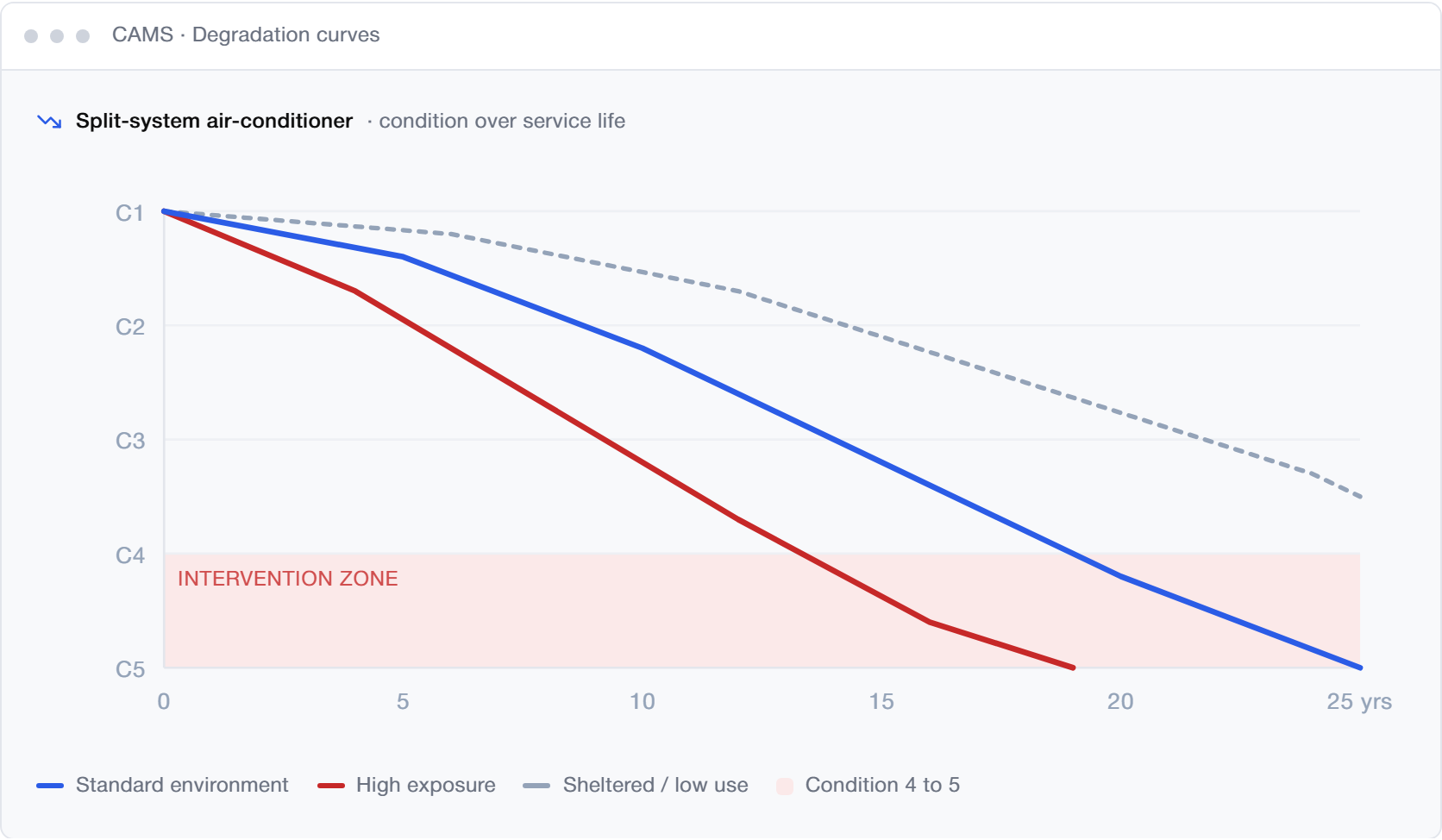
From asset age to predicted condition
Design life is not a guaranteed failure date. More than 900 asset-specific curves forecast the probability of an asset moving through each condition, adjusted for its actual condition, environment and utilisation.
- 900+ asset-specific deterioration curves
- Probability across condition states 1 to 5
- Adjusted for environment, exposure and criticality
From condition to a defensible budget
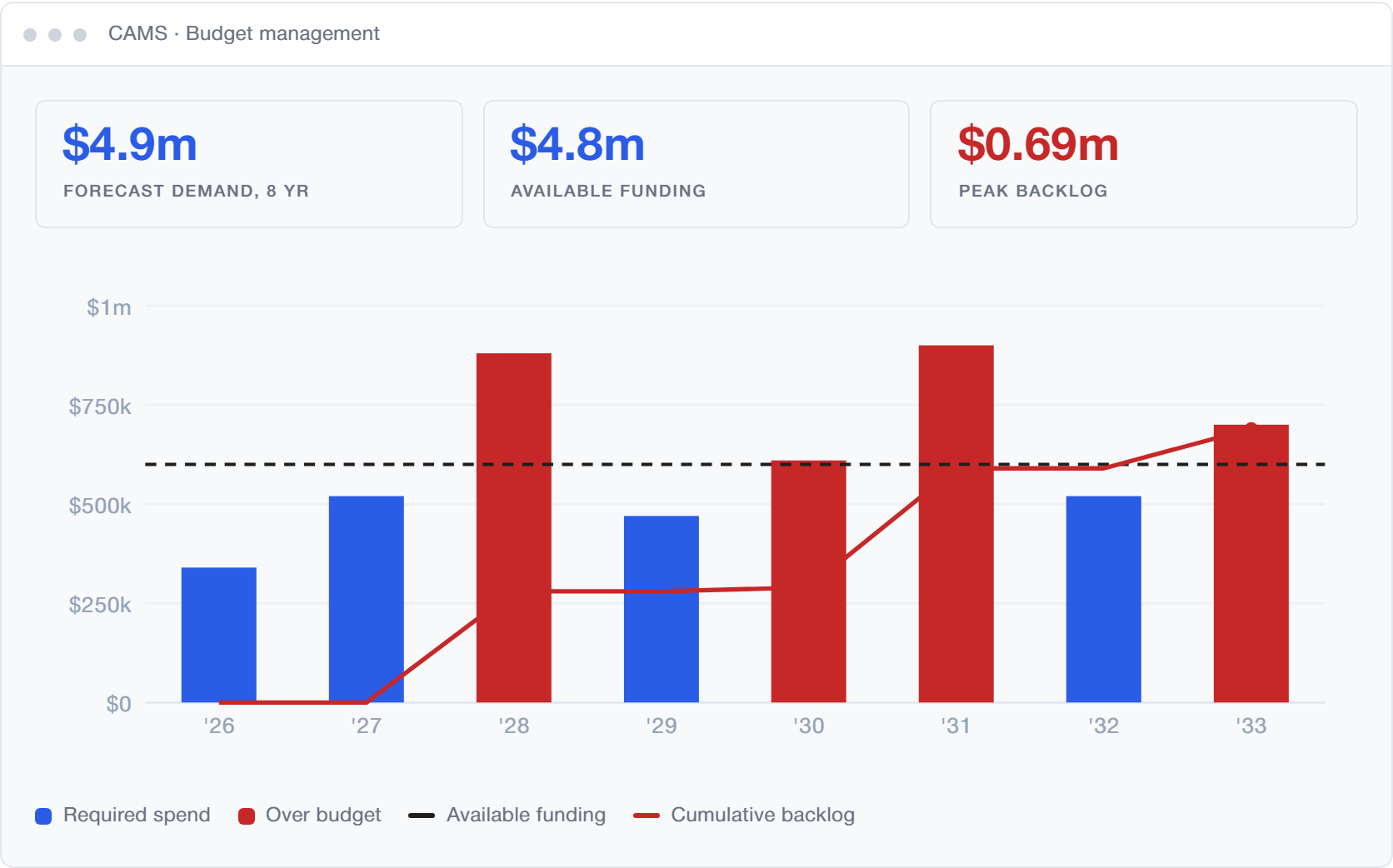
Deterioration predictions convert into capital, planned and reactive forecasts, then run against available funding to expose the years where renewals cluster and the budget cannot meet demand.
- Capital, planned and reactive cost projections
- Forecast demand against available funding
- Cumulative position, backlog and protected works
Compare strategies, prioritise by consequence
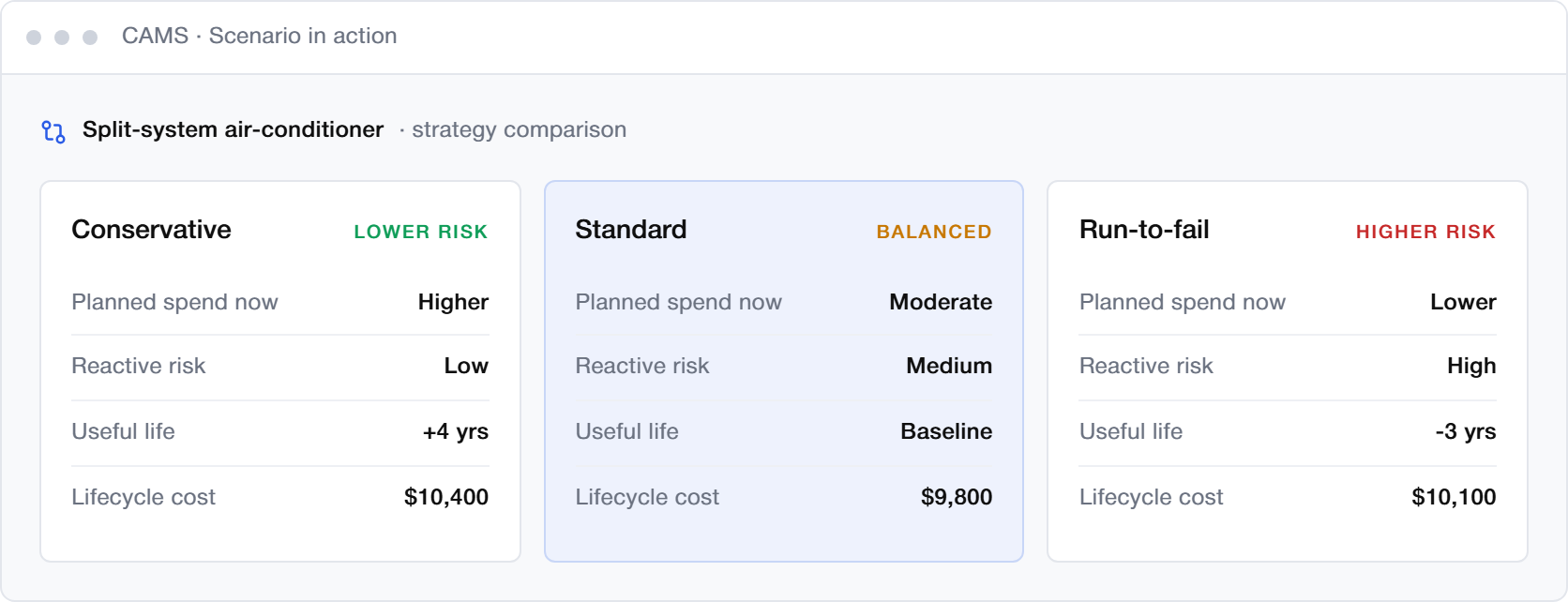
Test conservative, standard and run-to-fail strategies, and view the same forecast through criticality, so investment is directed by consequence of failure, not by treating every asset equally.
- Conservative, standard and run-to-fail strategies
- Cost, risk and useful-life comparison
- Expenditure separated by criticality
What sits behind the forecast
The modelling that turns an asset register into a long-term investment plan, built on research-based deterioration curves and the governed CAMS data.
Predictive deterioration modelling
More than 900 asset-specific, research-based curves, tailored to asset type and operating environment, forecast the probability of moving through each condition, not a single replacement date.
The coreLifecycle cost forecasting
Capital, planned and reactive expenditure projected across a 10, 20 or 25-year horizon, at portfolio, site or asset level.
Capital planningScenario comparison
Conservative, standard, run-to-fail and budget-constrained strategies compared for cost, risk and useful life.
What-ifIntervention timing analysis
Shows that deferral changes the scope, cost and risk of an intervention, not just the year it lands in.
Cost of delayBudget gaps and funding evidence
Forecast demand against available funding, with cumulative position, maintenance backlog and a defensible case for a funding submission.
DefensibleCriticality-based prioritisation
Investment directed by consequence of failure, protecting safety, compliance and essential services while deferring lower-criticality assets.
Risk-rankedValidated condition inputs
Inspection data is checked for range, completeness and consistency on capture, so forecasts rest on verified condition, not unverified field data.
Data integrityBuilt on real asset portfolios
CAMS is in service across large, asset-intensive estates, where the same predictive modelling supports inspection, maintenance and long-term capital planning.
Asset-intensive organisations
Suited to organisations managing large, complex or high-value asset portfolios that need to justify future funding and explain asset risk.
See CAMS on a nominated pilot site
CAMS is released to a pilot site for an initial term, then monitored and refined to support the contract. Model deterioration and budget on your own portfolio from there.
Request demo